About the Journal
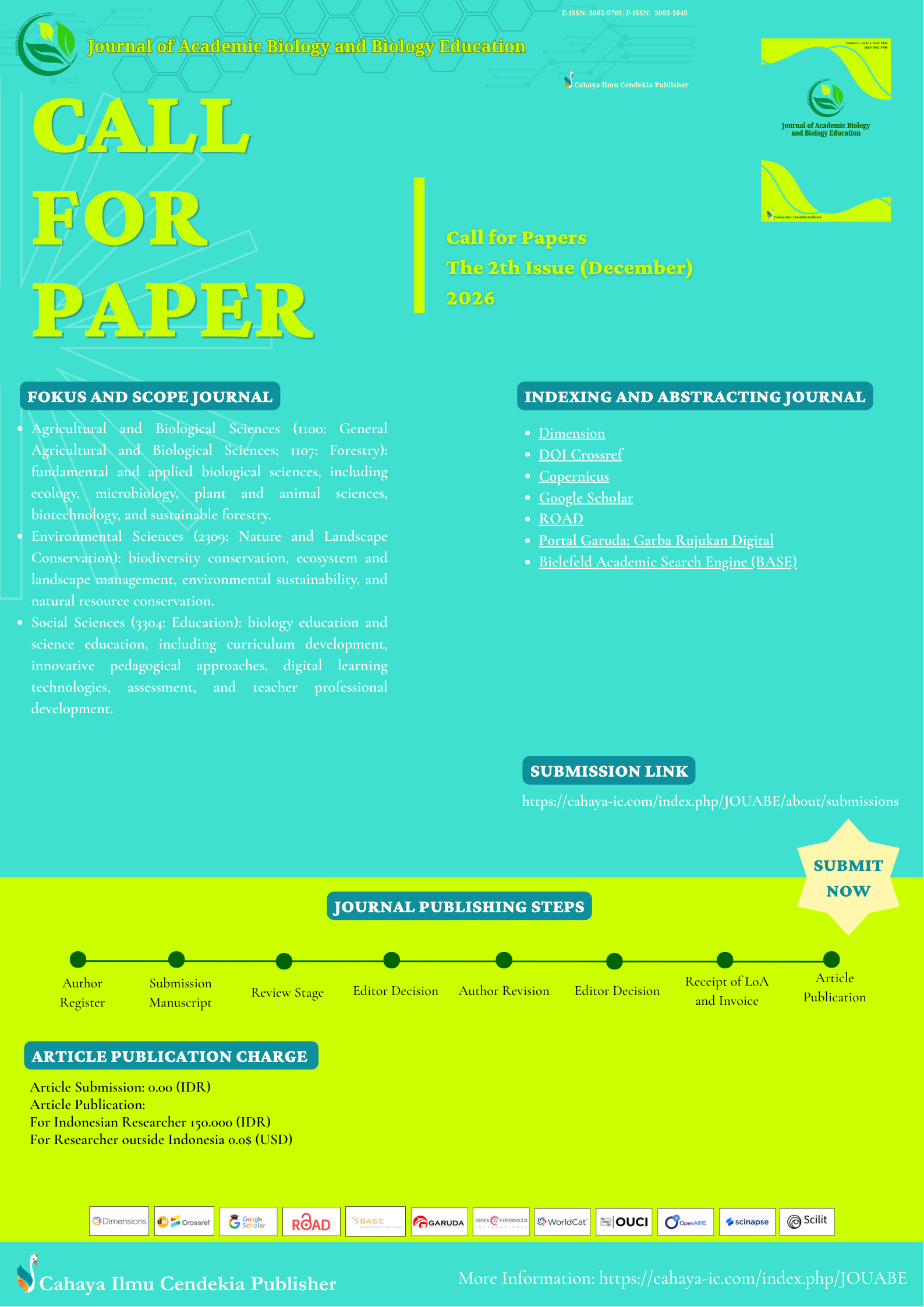
Journal of Academic Biology and Biology Education is an international, peer-reviewed, open-access journal published biannually (June and December). The journal implements a rigorous double-blind peer-review process to ensure the quality, originality, and academic integrity of all published articles.
The journal aims to advance interdisciplinary research at the intersection of biology, environmental sciences, and education, with a particular emphasis on addressing global and regional challenges in developing countries. It provides a platform for researchers, educators, and practitioners to disseminate innovative findings and theoretical contributions that support sustainable development and educational transformation.
The scope of the journal aligns with the All Science Journal Classification (ASJC) and includes the following areas:
- Agricultural and Biological Sciences (1100: General Agricultural and Biological Sciences; 1107: Forestry): fundamental and applied biological sciences, including ecology, microbiology, plant and animal sciences, biotechnology, and sustainable forestry.
- Environmental Sciences (2309: Nature and Landscape Conservation): biodiversity conservation, ecosystem and landscape management, environmental sustainability, and natural resource conservation.
- Social Sciences (3304: Education): biology education and science education, including curriculum development, innovative pedagogical approaches, digital learning technologies, assessment, and teacher professional development.
The journal publishes original research articles, review papers, and scholarly discussions that demonstrate methodological rigor, theoretical contribution, and practical relevance. Interdisciplinary and cross-sectoral studies are particularly encouraged.
By promoting open access to high-quality research, the journal supports global knowledge exchange and contributes to the advancement of science, environmental sustainability, and education at both local and international levels.












-
Vol. 3 No. 1 (2026): June
Articles
(1) Universitas Islam Negeri Maulana Malik Ibrahim (Indonesia) (2) Khukhan School (Thailand)pp. 1-23(1) Syarif Hidayatullah State Islamic University Jakarta (Indonesia)(2) Bonga College of Teachers Education (Ethiopia)pp. 24-32(1) Can Tho University (Viet Nam)(2) VNU University of Education (Viet Nam)pp. 33-42(1) Alauddin State Islamic University of Makassar (Indonesia)pp. 43-50(1) Syarif Hidayatullah State Islamic University Jakarta (Indonesia)pp. 51-61(1) Universitas Muhammadiyah Sumatera Barat (Indonesia)(2) Idlib University (Syrian Arab Republic)(3) Vietnam National University of Agriculture (Viet Nam)pp. 62-78(1) Universitas Labuhanbatu (Indonesia)(2) Kasetsart University (Thailand)(3) Kenya Marine and Fisheries Research Institute (Kenya)pp. 79-95(1) Kyambogo University (Uganda)(2) Peking University (China)(3) Vrije Universiteit Brussel (Belgium)pp. 96-109(1) University of Illinois Urbana-Champaign (United States)(2) Universitas Islam Negeri Maulana Malik Ibrahim (Indonesia)(3) University of Greifswald (Germany)pp. 110-123(1) University of Brawijaya (Indonesia)(2) University of Mauritius (Mauritius)(3) Colorado State University (United States)pp. 124-139(1) Royal University of Agriculture, Cambodia (Cambodia)(2) Svay Rieng University (Cambodia)pp. 140-145
Relationship between Learning Habits and Biology Learning Outcomes among Senior High School Students
(1) Islamic University of Riau (Indonesia)(2) State Junior High School 28 Pekanbaru (Indonesia)pp. 146-155(1) State Junior High School 33 Bandar Lampung (Indonesia)(2) Nusantara Junior High School Bandar Lampung (Indonesia)(3) Tirtayasa Junior High School Bandar Lampung (Indonesia)(4) Raden Intan State Islamic University (Indonesia)pp. 156-165(1) Walisongo State Islamic University (Indonesia)(2) University of Nairobi (Kenya)pp. 166-174(1) Universitas Islam Negeri Raden Intan Lampung (Indonesia)(2) State Senior High School 15 Bandar Lampung (Indonesia)pp. 175-184
 10.37251/jouabe.v3i1.3224